
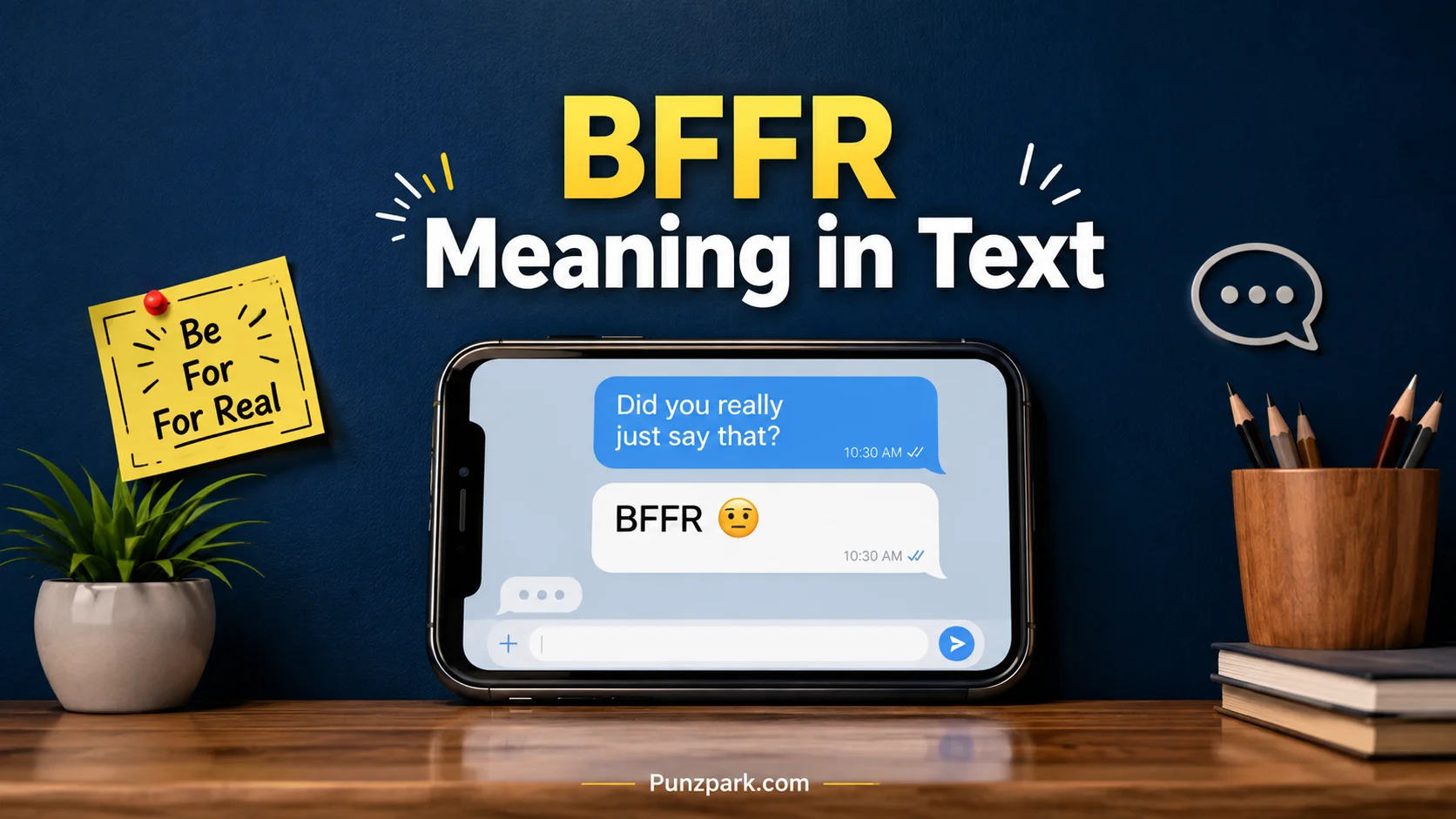
Have you ever received a message that simply said “BFFR” and wondered what it meant? You’re not alone. Internet slang changes fast. New abbreviations appear almost every day on TikTok, Snapchat, Instagram, and texting apps. Some disappear within weeks while others become part of everyday online conversations. BFFR is one of those expressions that quickly spread across social media because it is short, memorable, and expressive.
Understanding the BFFR meaning in text helps you avoid confusion and respond naturally in conversations. While the acronym looks simple, its tone can change depending on the situation. Sometimes it is playful and funny. Other times it can sound sarcastic or even blunt. This guide explains exactly what BFFR means, where it came from, when you should use it, and when you should avoid it. You’ll also find plenty of examples, comparisons, and practical tips so you can recognize the expression wherever you see it.
Quick Answer
BFFR stands for “Be F*ing For Real.”** People use it in text messages and on social media to tell someone to be realistic, stop exaggerating, or take a situation seriously. The phrase usually expresses disbelief, sarcasm, or frustration, although friends often use it jokingly.
Example:
Alex: “I could finish that whole project in ten minutes.”
Jordan: “BFFR. It took you two hours yesterday.”
In this example, BFFR means, “Come on, be realistic.”
What Does BFFR Mean in Text?
The BFFR meaning in text is straightforward once you know the phrase behind it. It stands for “Be F*ing For Real,”** an informal expression that encourages someone to stop joking, stop exaggerating, or admit what is actually true.
Unlike many texting abbreviations that simply save time, BFFR also carries emotion. It often shows disbelief or challenges a statement that sounds unrealistic. Instead of writing an entire sentence like, “There’s no way that’s true,” many people simply reply with BFFR because it gets the message across instantly.
The phrase is commonly used between friends who already understand each other’s sense of humor. In these conversations, it usually comes across as playful rather than offensive. However, context matters. If you send it to someone you don’t know well, it may sound rude because of the strong language behind the abbreviation.
Here are some common situations where people use BFFR in text messages:
- Someone makes an unbelievable claim.
- A friend exaggerates a story.
- Someone refuses to accept obvious facts.
- A person overreacts to a small issue.
- Someone posts an unrealistic opinion online.
Consider these examples:
| Text Message | Meaning |
| “You think you’ll become a millionaire by next week? BFFR.” | Be realistic. |
| “BFFR. You know that’s not what happened.” | Stop pretending or exaggerating. |
| “You’re saying you never study and still get perfect grades? BFFR.” | That sounds unbelievable. |
| “BFFR, you definitely ate the last slice.” | Playful accusation between friends. |
Although BFFR contains profanity in its full form, many people type only the abbreviation. That makes it feel less harsh in casual online conversations, but the intended meaning remains the same.
What Does BFFR Mean on Social Media?
While the BFFR meaning in text stays the same across most platforms, the way people use it can vary depending on the audience and the type of content. You’ll usually see BFFR in comment sections, captions, reaction videos, memes, and direct messages. It often serves as a quick response when someone makes an unbelievable statement or shares an opinion that others think is unrealistic.
Because social media moves quickly, short acronyms like BFFR help users express strong reactions without typing long replies. The phrase has become part of everyday internet language, especially among younger users.
BFFR Meaning on TikTok
TikTok played a major role in making BFFR popular. Creators use it in videos to react to unrealistic beauty trends, celebrity gossip, relationship advice, or viral challenges. Viewers also flood the comments with BFFR whenever they think someone is exaggerating or making an unreasonable claim.
For example, if a creator says they became fluent in a new language overnight, comments might include:
- “BFFR.”
- “Please BFFR.”
- “BFFR, nobody believes that.”
In these situations, the acronym acts as a humorous reality check rather than a serious insult.
BFFR Meaning on Instagram
On Instagram, BFFR often appears under reels, photos, and stories. People use it when reacting to edited images, luxury lifestyle posts, or dramatic opinions. Friends may also use it in direct messages while teasing each other.
Example:
Friend: “I didn’t even try on this test.”
Reply: “BFFR. You studied all weekend.”
Here, the response calls out an obvious exaggeration in a lighthearted way.
BFFR Meaning on X (Formerly Twitter)
Conversations on X move fast, and users often rely on short expressions to react instantly. BFFR appears in discussions about sports, entertainment, politics, and trending news whenever someone posts a claim that others consider unrealistic.
Instead of writing several sentences, users simply post “BFFR” to challenge the original statement. Because text on X is brief by nature, the acronym fits naturally into conversations.
BFFR Meaning on Snapchat
Snapchat conversations are usually casual and personal, making BFFR common among close friends. You might see it after someone tells an unbelievable story or jokes about a situation.
For example:
Friend: “I’m never texting them again.”
You: “BFFR. You’ll text them tonight.”
The message is playful because both people understand the joke.
BFFR Meaning on Facebook
Although Facebook has users of all ages, BFFR still appears in comments, meme pages, and community groups. Younger users tend to recognize it immediately, while older users may ask what it means.
Since Facebook includes family members, coworkers, and acquaintances, it’s wise to consider your audience before using slang that contains implied profanity.
Does the Meaning Change Across Platforms?
No. The BFFR meaning in text remains the same whether you see it on TikTok, Instagram, Snapchat, Facebook, X, or in a private message.
What changes is the tone.
| Platform | Typical Tone | Common Use |
| TikTok | Funny, sarcastic | Reaction videos and comments |
| Casual, playful | Reels, stories, DMs | |
| X (Twitter) | Direct, opinionated | Trending discussions |
| Snapchat | Friendly, humorous | Private conversations |
| Casual | Memes and comment sections |
The more familiar you are with the person, the more likely BFFR will sound playful instead of rude.
Where Did BFFR Come From?
Although BFFR became widely recognized through social media, the expression behind the acronym existed long before it became an internet trend. The phrase “Be for real” has appeared in everyday English for decades. People have traditionally used it to question unbelievable statements or encourage someone to admit the truth.
Over time, speakers added emphasis by inserting a stronger word into the phrase, creating “Be F*ing For Real.”** As texting culture grew, internet users shortened the expression to BFFR, making it easier to type while preserving its impact.
The abbreviation gained massive attention when influencers, comedians, and content creators began using it in short videos. Viewers quickly adopted it because it was expressive, easy to remember, and perfect for reacting to exaggerated stories.
Several factors helped BFFR spread rapidly across the internet:
- Short-form video content increased its visibility.
- Meme culture encouraged repeated use.
- Influencers introduced it to millions of followers.
- Comment sections rewarded quick, relatable reactions.
- Younger users adopted it as part of everyday online slang.
Unlike many internet expressions that disappear after a few months, BFFR continues to appear because it communicates a common reaction in just four letters.
Another reason for its popularity is versatility. The same acronym works in humorous conversations, friendly debates, and online discussions without requiring a lengthy explanation. Whether someone exaggerates their achievements, makes an unrealistic prediction, or tells an unbelievable story, BFFR immediately signals skepticism.
Today, BFFR is recognized across many English-speaking online communities and remains one of the most widely used modern texting abbreviations for calling someone back to reality.
How to Use BFFR in Text Messages
Knowing the BFFR meaning in text is only part of the picture. You also need to understand when it fits the conversation. Since the acronym comes from a strong phrase, it works best in relaxed chats with people who understand your humor. Using it in the wrong setting can make you sound harsher than you intend.
A good rule is simple: if you wouldn’t comfortably joke with the person face to face, you probably shouldn’t send BFFR in a message.
Here are some of the most common ways people use it.
Calling Out an Exaggeration
One of the biggest reasons people type BFFR is to challenge an exaggerated statement.
Example
Friend: “I’m the fastest runner in the whole school.”
You: “BFFR. You finished fifth last week.”
The reply doesn’t necessarily start an argument. Instead, it playfully reminds the other person to be honest.
Responding to Unrealistic Plans
Sometimes people make plans that sound impossible or highly unlikely. BFFR offers a quick reality check.
Example
Sam: “I’ll finish this 30-page report in twenty minutes.”
Chris: “BFFR. Just focus on one section at a time.”
Here, the response encourages a more realistic expectation.
Teasing Friends
Close friends often use BFFR as part of everyday joking. The tone depends on your relationship, not just the words.
Example
Friend: “I’m never eating dessert again.”
Reply: “BFFR. I know you’re ordering cake tomorrow.”
Instead of sounding mean, the message adds humor to the conversation.
Reacting to Opinions
Social media users often respond with BFFR when they strongly disagree with someone’s opinion.
Example
“You’re saying that was the greatest movie ever made? BFFR.”
The reply shows disagreement while keeping the message short.
Responding to Excuses
People also use BFFR when they believe someone’s excuse isn’t believable.
Example
“I forgot because my phone disappeared.”
“BFFR. You were online all day.”
The phrase questions the explanation without writing a long response.
Quick Examples
| Situation | Example |
| Friend exaggerates | “BFFR. That never happened.” |
| Unrealistic goal | “BFFR. That’ll take more than one day.” |
| Funny argument | “BFFR. You know I’m right.” |
| Social media comment | “BFFR. That’s not even close.” |
| Group chat joke | “BFFR 😂” |
Although the abbreviation is common online, remember that every conversation has a different tone. Some people see BFFR as harmless slang, while others may interpret it as disrespectful. Think about your audience before pressing Send.
Examples of BFFR in Everyday Conversations
Reading real conversations makes the BFFR meaning in text much easier to understand. Notice how the tone changes depending on the relationship between the people involved.
Between Friends
Emma: “I could beat any professional basketball player.”
Lily: “BFFR. You haven’t played in months.”
Jake: “I wasn’t hungry.”
Ryan: “BFFR. You ate two burgers.”
Family Chat
Brother: “Mom won’t notice if we skip cleaning.”
Sister: “BFFR. She always notices.”
School Conversation
Student: “I didn’t study at all.”
Friend: “BFFR. I saw you in the library every day.”
Workplace Conversation
In casual chats between coworkers who know each other well, someone might say:
Coworker: “I’ll answer all 200 emails before lunch.”
Friend: “BFFR. Let’s just finish the urgent ones first.”
Even in relaxed offices, avoid using BFFR with managers, clients, or formal business contacts.
Online Gaming
Player 1: “I carried the whole team.”
Player 2: “BFFR. We all contributed.”
Gaming communities frequently use internet slang because conversations happen quickly during matches.
Group Chat
Friend: “I’m deleting all my social media tonight.”
Another Friend: “BFFR. You’ll be back tomorrow.”
The response is clearly playful because everyone understands the joke.
Comment Section
Post: “This is the easiest exam anyone will ever take.”
Comment: “BFFR. Half the class failed.”
Comment sections are one of the most common places to see BFFR because users often react instantly to bold opinions.
What Tone Does BFFR Convey?
Although the BFFR meaning in text stays consistent, its emotional tone changes depending on the conversation. That’s why two identical messages can feel completely different.
Here are the most common tones associated with BFFR.
Playful
Friends often use it while joking.
“BFFR. You know you’re ordering pizza tonight.”
Nobody feels offended because everyone understands the humor.
Sarcastic
The phrase frequently carries sarcasm when someone makes an unbelievable statement.
“You finished the project in five minutes? BFFR.”
The speaker clearly doubts the claim.
Frustrated
If someone repeats the same excuse or ignores obvious facts, BFFR may express annoyance.
“BFFR. We’ve already talked about this.”
Here, the tone is noticeably stronger.
Honest
Sometimes people use BFFR simply because they want someone to face reality.
For example, a friend might encourage another friend to stop making excuses and move forward.
Blunt
Because the original phrase contains profanity, BFFR naturally sounds more direct than expressions like “Seriously?” or “Be realistic.”
That bluntness explains why the acronym works well among close friends but may seem rude in formal conversations.
Tone Comparison
| Tone | Example | How It Feels |
| Funny | “BFFR 😂” | Lighthearted |
| Playful | “BFFR, you love that song.” | Friendly |
| Sarcastic | “BFFR. Nobody believes that.” | Skeptical |
| Frustrated | “BFFR. Stop making excuses.” | Annoyed |
| Blunt | “BFFR.” | Direct |
A simple emoji, punctuation mark, or previous message can completely change how BFFR is interpreted. That’s why reading the entire conversation—not just the acronym—is always important.
When You Shouldn’t Use BFFR
Although BFFR is common in casual conversations, it doesn’t belong in every situation. Since the full phrase behind the acronym contains profanity, using it in the wrong setting can make you appear unprofessional or disrespectful. Before sending it, think about who you’re talking to and whether the conversation is formal or informal.
Here are situations where you should avoid using BFFR.
Professional Emails
Business emails should remain respectful and professional. Even though BFFR is written as an abbreviation, many people know what it stands for. Using it in workplace communication can leave a poor impression.
Instead of saying:
“BFFR. That’s impossible.”
You could write:
“I don’t think that’s a realistic timeline.”
Customer Communication
Whether you’re speaking with a customer, client, or business partner, choose polite language over internet slang. Clear communication builds trust, while slang can create confusion or seem dismissive.
Academic Writing
School assignments, research papers, and formal presentations should use standard English rather than texting abbreviations. Teachers and professors expect clear, professional language.
Formal Conversations
When speaking with someone you don’t know well, it’s safer to avoid slang like BFFR. What sounds funny to one person may sound rude to another.
Older Audiences
Not everyone follows internet trends. Someone unfamiliar with online slang may not understand BFFR at all, forcing you to explain the acronym and interrupting the conversation.
Better Alternatives
If you want to express the same idea politely, consider these phrases instead.
| Instead of BFFR | Use This |
| BFFR | Be realistic. |
| BFFR | Seriously? |
| BFFR | I don’t think that’s accurate. |
| BFFR | Let’s be honest. |
| BFFR | That seems unlikely. |
Choosing the right words for the situation helps your message come across the way you intend.
Read More: CLFS Meaning in Text: What It Means, and How to Use It
Is BFFR Rude?
One of the most common questions about the BFFR meaning in text is whether it’s rude. The honest answer is it depends on the context.
Among close friends, BFFR is often nothing more than playful teasing. Everyone understands the joke, so nobody takes offense.
For example:
Friend: “I’m definitely waking up at 5 a.m. tomorrow.”
Reply: “BFFR. You snooze your alarm five times.”
Most people would laugh at this exchange because it’s based on a shared joke.
However, the tone changes if you use BFFR during an argument or with someone you barely know. In those cases, the message may sound dismissive or disrespectful because the underlying phrase is quite strong.
Several factors influence how people interpret BFFR:
- Your relationship with the other person.
- The topic of the conversation.
- Previous messages.
- Punctuation and capitalization.
- Emojis or other reactions.
- Whether the discussion is serious or lighthearted.
Compare these examples.
| Message | Likely Tone |
| “BFFR 😂” | Friendly and playful |
| “Please BFFR.” | Calm but skeptical |
| “BFFR!” | Strong disagreement |
| “BFFR. Stop lying.” | Harsh and confrontational |
If you’re unsure how someone might react, it’s usually better to choose a less direct phrase. Good communication isn’t just about what you say. It’s also about how your words make the other person feel.
How to Respond to BFFR
Receiving BFFR doesn’t always mean someone is attacking you. Often, they’re simply challenging your statement or joking around. The best response depends on the situation and your relationship with the sender.
Admit You Were Exaggerating
Sometimes the easiest response is simply acknowledging that you overstated something.
You: “Fair enough. I was exaggerating.”
This keeps the conversation relaxed.
Laugh It Off
If the discussion is clearly playful, respond with humor.
Friend: “BFFR.”
You: “Okay, okay. You caught me.”
A lighthearted reply usually keeps the conversation enjoyable.
Explain Your Point
If you genuinely believe your statement is correct, calmly explain your reasoning.
You: “I know it sounds surprising, but here’s why I think that.”
Providing context often works better than arguing.
Ask for Clarification
Occasionally, someone replies with BFFR without explaining why.
You can simply ask:
- “What part don’t you believe?”
- “Why do you think that?”
- “Can you explain?”
This encourages a more productive conversation.
Stay Respectful
If the discussion becomes heated, avoid matching an aggressive tone. Remaining calm usually leads to a better outcome than responding with more sarcasm.
BFFR vs. Similar Internet Slang
Many texting abbreviations express surprise, honesty, or disagreement. While they may appear similar, each has its own meaning and tone.
| Acronym | Full Form | Meaning | Typical Tone |
| BFFR | Be F***ing For Real | Be realistic | Blunt |
| FR | For Real | Seriously or truly | Neutral |
| TBH | To Be Honest | Honest opinion | Honest |
| NGL | Not Gonna Lie | Honest admission | Casual |
| SMH | Shaking My Head | Disapproval | Disappointed |
| IKR | I Know, Right? | Agreement | Friendly |
| IDC | I Don’t Care | Indifference | Dismissive |
| LOL | Laugh Out Loud | Laughter | Humorous |
BFFR vs. FR
People often confuse BFFR with FR, but they serve different purposes.
| BFFR | FR |
| Challenges someone | Agrees or emphasizes something |
| More emotional | More neutral |
| Often sarcastic | Often sincere |
Example
FR: “That movie was amazing.”
BFFR: “That movie was amazing? BFFR.”
The first statement agrees with an opinion. The second questions it.
Similar Acronyms to BFFR
If you spend time online, you’ll probably encounter several expressions that convey similar emotions.
- FR – For Real
- TBH – To Be Honest
- NGL – Not Gonna Lie
- SMH – Shaking My Head
- IKR – I Know, Right?
- OMG – Oh My God
- BRUH – Expression of disbelief or frustration
- NO WAY – Surprise or disbelief
- IDC – I Don’t Care
Although these abbreviations overlap in some situations, BFFR is unique because it specifically tells someone to stop exaggerating or accept reality.
Here are the final sections of the article.
FAQs:
What does BFFR mean in text?
BFFR stands for “Be F*ing For Real.”** People use it in text messages, social media posts, and online chats to tell someone to be realistic, stop exaggerating, or take a situation seriously. The acronym is most common in casual conversations among friends.
Is BFFR considered rude?
It can be. The tone depends on the conversation and your relationship with the other person. Friends often use BFFR jokingly, but it may sound blunt or disrespectful in serious discussions or when used with someone you don’t know well.
Is BFFR only used on TikTok?
No. Although TikTok helped popularize the term, BFFR is widely used on Instagram, Snapchat, X (formerly Twitter), Facebook, Discord, Reddit, and in everyday text messages. Its meaning stays the same across platforms.
How should I respond if someone texts me BFFR?
Your response depends on the context. If they’re joking, you can laugh it off or admit you were exaggerating. If they’re challenging your opinion, explain your point calmly or ask why they disagree. Staying respectful usually keeps the conversation productive.
Should I use BFFR in professional conversations?
No. BFFR is internet slang based on a phrase that includes profanity, so it isn’t appropriate for business emails, workplace communication, academic writing, or formal conversations. In professional settings, use alternatives such as “Let’s be realistic,” “I don’t think that’s accurate,” or “That seems unlikely.”
Conclusion:
Understanding the BFFR meaning in text makes it easier to follow modern online conversations and respond naturally. The acronym stands for “Be F*ing For Real”** and is commonly used to challenge exaggerated claims, express disbelief, or encourage someone to face reality. While it often appears in humorous exchanges between friends, its direct tone means it isn’t suitable for every situation.
Whether you see BFFR on TikTok, Instagram, Snapchat, X, Facebook, or in a text message, the meaning remains consistent. The key is to pay attention to the context, the relationship between the people involved, and the overall tone of the conversation. Used appropriately, BFFR can add humor and emphasis to casual chats. Used carelessly, it can come across as unnecessarily harsh.
